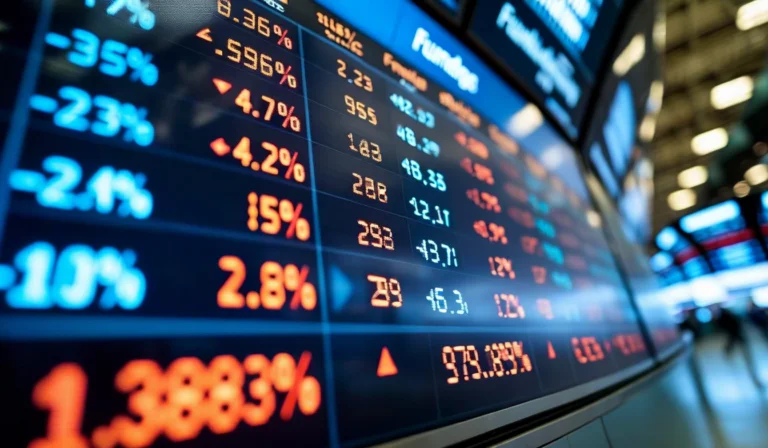
Funding rates are a mechanism, not a fee. The distinction matters more than most traders realize, because once you understand what the mechanism is trying to do, the numbers start to make sense.
Why funding rates exist
A perpetual futures contract has no expiry, which means there's no natural moment where the futures price and the spot price converge. Traditional futures converge at expiry because you have to settle at the index price. Without expiry, you need something else to keep the perpetual price anchored to the underlying.
Funding rates are that anchor. When the perpetual is trading above spot (bullish market sentiment), the funding rate is positive: longs pay shorts. This makes holding a long position more expensive, which creates selling pressure on the perpetual, which brings the price back toward spot. When the perpetual is below spot (bearish), shorts pay longs, creating buying pressure. Market participants responding to their financial incentives do the price discovery work.
Reading the funding rate as market signal
Funding rates tell you something useful about market sentiment. Persistently high positive funding means there's sustained demand to be long on leverage. Persistently negative funding means there's sustained demand to be short. Both conditions can persist longer than you'd expect — they're not automatic reversal signals. But extreme funding rates often precede corrections, because they represent a cost that eventually becomes unsustainable for the side paying it.
During the period of extreme market stress in early 2022, some perpetual markets saw annualized funding rates above 200% for extended periods. Traders who understood this as a signal (rather than a fee to be ignored) adjusted their positioning accordingly.
How the rate is calculated
The specific formula varies by protocol, but the general structure is: funding rate = premium index + interest rate component. The premium index measures how far the perpetual is trading from the spot index. The interest rate component is typically a small constant that accounts for the cost of borrowing the collateral asset.
Funding is usually settled every eight hours. Some protocols calculate and settle in real time, which eliminates the discrete funding payment structure and makes the cost of carry more continuous. Aark's approach settles funding continuously, which means the cost you're paying is always the current market rate rather than a snapshot from eight hours ago.
Funding rate arbitrage
When funding rates are extreme, they create arbitrage opportunities between the perpetual market and the spot market. If annualized funding is 100% positive, a trader can go short on the perpetual and long on spot, earning the funding rate while remaining delta-neutral on price. This is a well-known trade — called the "cash and carry" in traditional finance and the "funding rate arb" in crypto.
The reason this arb doesn't fully eliminate high funding is that it has costs and risks. Going long spot requires capital. Maintaining the delta hedge requires active management. There's liquidation risk on the short leg if the perpetual runs up significantly before the hedge can be adjusted. These friction costs mean the funding rate arb only fully closes the gap at the extremes — normal positive funding persists because it's too small to arbitrage profitably after costs.
How funding rates affect your trading strategy
Traders who hold positions for days or weeks need to model funding as a carrying cost, the same way a futures trader models basis. A trade that's profitable by 2% over five days might break even or lose slightly when you account for funding paid at a 50% annualized rate.
The math is simple: at 0.1% per 8-hour period (roughly 109% annualized), holding a long for one week costs about 2.1% of your position notional in funding payments. A 5x leveraged position with that carry needs to appreciate 10.5% in a week just to cover the funding cost. That's a high bar in any market.
Practical note: check the current and historical funding rate before entering any position you plan to hold overnight. It's free information that directly affects your break-even. Treating it as background noise is leaving money on the table.
Funding rate extremes as signals
Extremely negative funding — above -0.05% per period — is rarer than extreme positive funding, but historically it's been a stronger signal. Sustained negative funding means market participants are so bearish they're willing to pay to be short, and that level of consensus pessimism has often coincided with market bottoms. Not always, and it's not a sufficient signal on its own, but it's a data point worth tracking.
The broader lesson is that funding rates are real-time market sentiment data, updated continuously, fully transparent, and specific to the leveraged market. That's a more direct window into speculative positioning than most traditional sentiment indicators. If you're trading perpetuals and not monitoring funding, you're ignoring one of the few genuinely informative signals the mechanism produces.
Continue Reading
How Perpetual DEXs Actually Work
Cross-Margin vs Isolated: What Traders Need to Know