When you open a perpetuals position, the margin mode you select is not a preference — it is a structural choice that determines how your liquidation price is calculated and what else gets pulled into the collateral pool when things move against you. Most traders make this choice once, leave it on the default, and never revisit it. That default is usually cross-margin. The reasons that is not always the right answer are worth understanding precisely.
The Basic Definitions and Why They Diverge
In isolated margin, you allocate a fixed amount of collateral to a specific position. That position's liquidation price is determined entirely by the collateral you assigned. If the market moves against you past the maintenance margin threshold, you are liquidated — but only that position's allocated collateral is lost. The rest of your account balance is untouched.
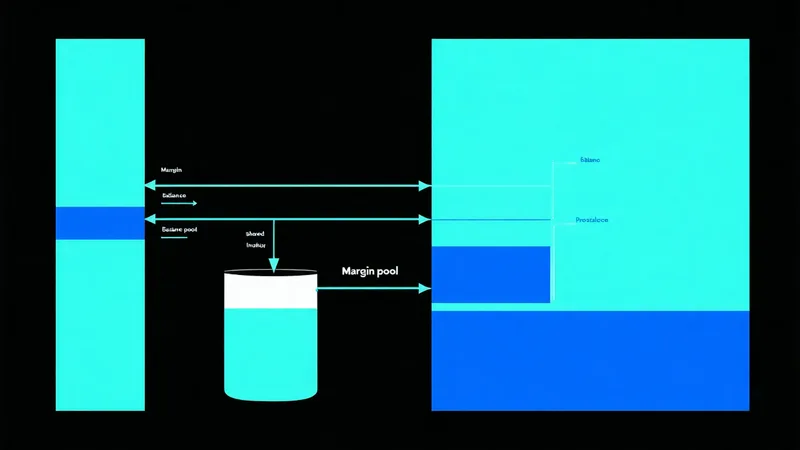
In cross-margin, your entire account balance acts as the collateral pool for all open positions simultaneously. Each position's unrealized P&L and margin requirement draws from the same shared pool. Profitable positions effectively subsidize losing ones. A position that would trigger a liquidation in isolated mode may survive in cross mode because the winning position's equity offsets the deficit.
The simplified liquidation price formula for isolated margin:
Liquidation Price (long) ≈ Entry Price × (1 − 1/Leverage + Maintenance Margin Rate)For cross-margin, the effective threshold shifts dynamically as your other positions gain or lose value. There is no single static liquidation price — the threshold is a function of total account equity vs. total maintenance margin requirement across all open positions.
The Cascade Risk Specific to Cross-Margin
The shared collateral pool in cross-margin creates a specific cascade path that isolated margin does not have. Consider a trader carrying three positions simultaneously: a long ETH, a long SOL, and a short BTC. In a correlated drawdown — the kind that hits when risk-off sentiment moves through the entire crypto asset class simultaneously — all three positions may move against the trader at once. In isolated mode, each liquidation is independent and bounded. In cross-margin, all three draw on the same equity pool. The losing positions collectively erode the margin faster than any single position would alone.
The scenario that produces the worst outcome in cross-margin: a trader opens a large cross-margin long with a thin buffer above maintenance margin, then adds smaller positions that are also directional. A sudden gap down touches the liquidation threshold for the large position. The liquidation engine closes it at market, but the act of liquidating also removes the position's maintenance margin contribution from the pool's accounting — and the smaller positions, now without the large position's offsetting unrealized P&L, may simultaneously hit their own thresholds. The result is a sequence of liquidations triggered by the same event.
We are not saying cross-margin is dangerous by design — we are saying the shared-pool mechanic means that position sizing and correlation awareness matter more in cross-margin than they do in isolated. A trader running uncorrelated positions with real equity buffers in cross-margin faces very different risk than a trader running correlated longs with minimal margin buffer.
When Isolated Margin Is the Cleaner Choice
Isolated margin makes sense when you want a defined maximum loss on a specific position. You know the collateral at risk before you open. That characteristic is valuable in three specific situations:
- High-conviction directional plays with tight conviction windows. You have a specific thesis with a specific stop. You want the position to run to liquidation (or close early) without any possibility that the protocol will extend it by borrowing from other positions' equity.
- High-volatility or low-liquidity pairs. On a small-cap perpetual, the mark price can gap through your intended stop. Isolated margin caps the damage. Cross-margin on the same pair means a bad wick can consume equity from completely unrelated positions.
- Systematic strategies where maximum loss per position is a parameter. If you are running a portfolio of uncorrelated perpetual positions systematically, isolated margin per position lets you model expected maximum loss in a way that is structurally impossible in cross-margin without careful real-time margin tracking.
When Cross-Margin Actually Helps
Cross-margin has a legitimate use: hedging. If you run a long ETH spot position and a short ETH perpetual as a basis trade or delta-neutral strategy, cross-margin lets the profit from the short offset margin calls on the long — or vice versa — without you manually transferring funds between positions. The net delta is what matters, and cross-margin correctly pools it.
It also helps when you want to maximize capital efficiency on a single concentrated position where you trust your stop discipline. A single position in cross-margin with 60% of your account balance gives you more room before liquidation than the same position in isolated mode with 20% allocated — because the other 80% of unused balance acts as a buffer. But this only makes sense if that remaining balance is genuinely available and not deployed elsewhere in correlated risk.
The Liquidation Math That Changes Between Modes
Let's make this concrete with a synthetic example. A trader opens a 5× long ETH-PERP at an entry price of $3,400. The protocol's maintenance margin rate is 0.5%.
Isolated margin, allocated collateral $680 (20% of notional):
Effective leverage = 5×. Liquidation price ≈ $3,400 × (1 − 0.20 + 0.005) = approximately $3,400 × 0.805 = ~$2,737. A roughly 19.5% adverse move triggers liquidation. That is the maximum loss: $680.
Cross-margin, full account balance $3,400 (one position, no others):
The effective margin ratio is 100% of notional, effectively 1× from a margin perspective. Liquidation price is dramatically lower — approaching zero after accounting for maintenance margin. But if the trader adds a second correlated long using the same pool, the combined maintenance margin requirement rises and the effective buffer per position shrinks.
The point is not that one number is better than the other — it is that in cross-margin, the liquidation price for any given position is a moving target that depends on the state of all other positions in the account. Checking your cross-margin liquidation price once when you open is not sufficient if you then open additional positions or if other positions generate unrealized losses.
What to Actually Check Before You Size In
In Aark's terminal, you can run a position margin simulator before executing. The inputs are margin mode, leverage, entry price, and account balance. The output is the effective liquidation price and the equity buffer above maintenance margin at current mark price. For cross-margin accounts with multiple positions, the simulator shows the aggregate maintenance margin ratio — the metric protocols actually use when evaluating whether to trigger liquidation.
The ratio to watch: account equity / total maintenance margin requirement. When this falls below 1.0, liquidation begins. In quiet markets, this ratio can look comfortable. In a fast-moving correlated drawdown, it can move from 2.5 to 0.8 in a single candle if you are carrying correlated longs at scale.
Margin mode is a structural decision. Make it deliberately, model the liquidation math before you open, and revisit it when you add new positions to the same account. The UI default was not chosen based on your specific risk profile.